V2, v3 and v3.5.
The same inputs, side by side.
100 matched trials attempted across 50 distinct inputs. Plan: 100 trials per version, 50 inputs repeated twice across 21 families. Both language directions; typed text and saved recordings. Original 20 plus resumed 80; no replay.
COMPLETE300 planned runsTwo measurement segmentsCode unchanged · daily allowance increasedFirst audio means the first received MP3 bytes, which may precede the first decodable frame. These measurements do not include microphone capture, Bluetooth delivery, audible onset, or a pronunciation listening score.
What these measurements show
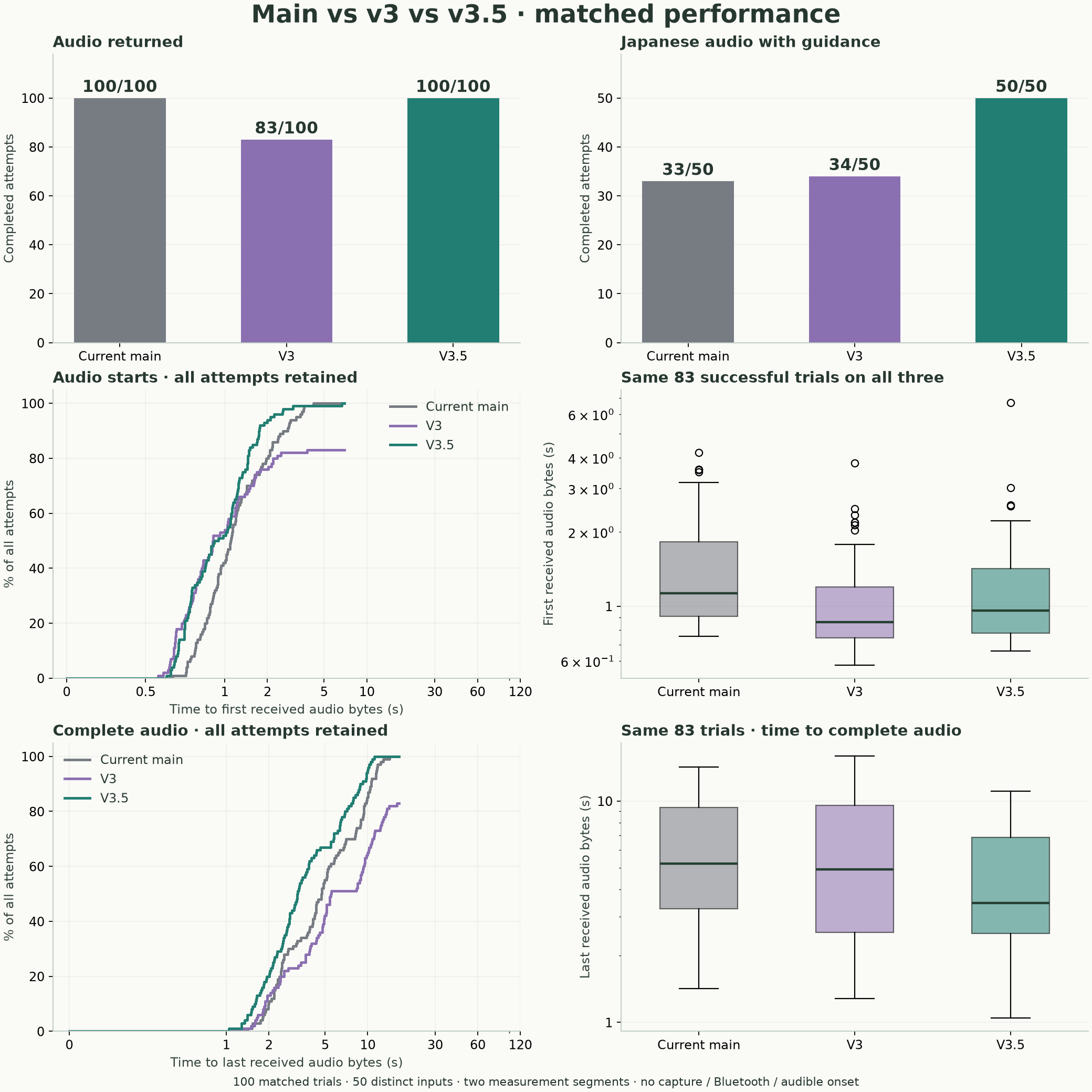
- V3.5 returned audio for 100/100 attempts, with guidance on all 50/50 Japanese outputs. V2 returned 17 Japanese clips without guidance. V3 had 16 guidance failures and 1 temporary service response (503) on English output.
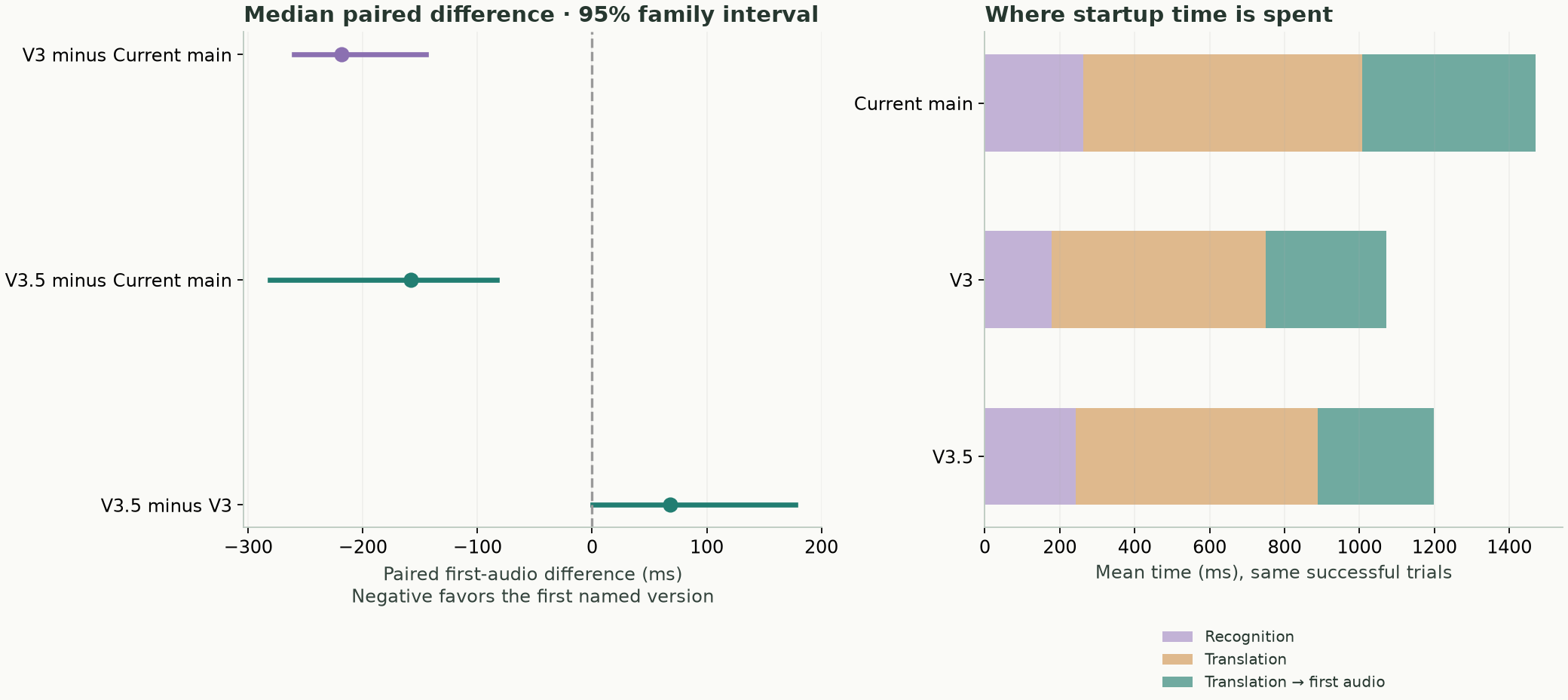
- Across all 100 matched trials, v3.5 received its first audio bytes a median 126 ms sooner than V2 (95% family interval: 53–275 ms sooner).
- On the 83 trials with complete audio from all three versions, v3.5’s first received bytes arrived a median 68 ms later than v3 (interval: 0.46–177.5 ms later), while its final audio bytes arrived 1,198 ms sooner (interval: 512–1,796 ms sooner). These are paired changes, not differences between separate medians.
- Within 2 seconds, the first bytes of clips that ultimately completed had arrived for 80/100 V2, 76/100 v3 and 94/100 v3.5 attempts. Failed attempts remain in these denominators.
- The faster startup version switched between v3.5 and V2 across repeats for 26/50 inputs. This does not yet support a stable rule for choosing a version from the input.
The intervals describe this corpus and the two observed measurement segments. Received bytes are not audible onset; these results do not establish pronunciation accuracy or listening quality.
Availability first, then speed
Guided Japanese audio is reported separately: the V2 site can speak without guidance, while v3 and v3.5 require it. A returned clip is not proof that its pronunciation or meaning is correct.
| Version | Audio returned | Guided Japanese | First audio · median | First audio · p90 | Last bytes · median | Last bytes · p90 |
|---|---|---|---|---|---|---|
| V2 | 100/100 | 33/50 | 1,131 ms | 2,767 ms | 5.22 s | 10.66 s |
| V3 | 83/100 | 34/50 | 863 ms | 1,679 ms | 4.92 s | 12.32 s |
| V3.5 | 100/100 | 50/50 | 960 ms | 1,744 ms | 3.45 s | 9.68 s |
Availability uses attempted denominators, with English → Japanese attempts counted separately. Unstarted planned trials are excluded. Reliability is measured across all 100 attempts per version in the completed study. Timing columns use only the same 83 successful trials on all three versions. P90 is the nearest-rank 90th percentile.
Matched gains and losses
Negative differences favor the first named version. Each row below uses all successful pairs for that comparison; the figure uses the common three-version subset. Confidence intervals resample complete scenario families 5,000 times, preserving related repetitions.
| Candidate − reference | Matched pairs | Median paired change | 95% family interval | Candidate faster |
|---|---|---|---|---|
| V3 − V2 | 83 | -218 ms | -260 ms to -145 ms | 65/83 |
| V3.5 − V2 | 100 | -126 ms | -275 ms to -53 ms | 62/100 |
| V3.5 − V3 | 83 | 68 ms | 0 ms to 177 ms | 32/83 |
Do patterns persist across inputs?
The two groups below reuse the previous study’s input-only clustering. Their membership was fixed before this run; new performance results were not used to redefine them.
| Input group | V2 | V3 | V3.5 |
|---|---|---|---|
| Shorter / fewer constraints Frozen group 1 · 25 planned inputs | 50/50 audio 8/20 guided Japanese | 37/50 audio 8/20 guided Japanese | 50/50 audio 20/20 guided Japanese |
| Longer / more constraints Frozen group 2 · 25 planned inputs | 50/50 audio 25/30 guided Japanese | 46/50 audio 26/30 guided Japanese | 50/50 audio 30/30 guided Japanese |
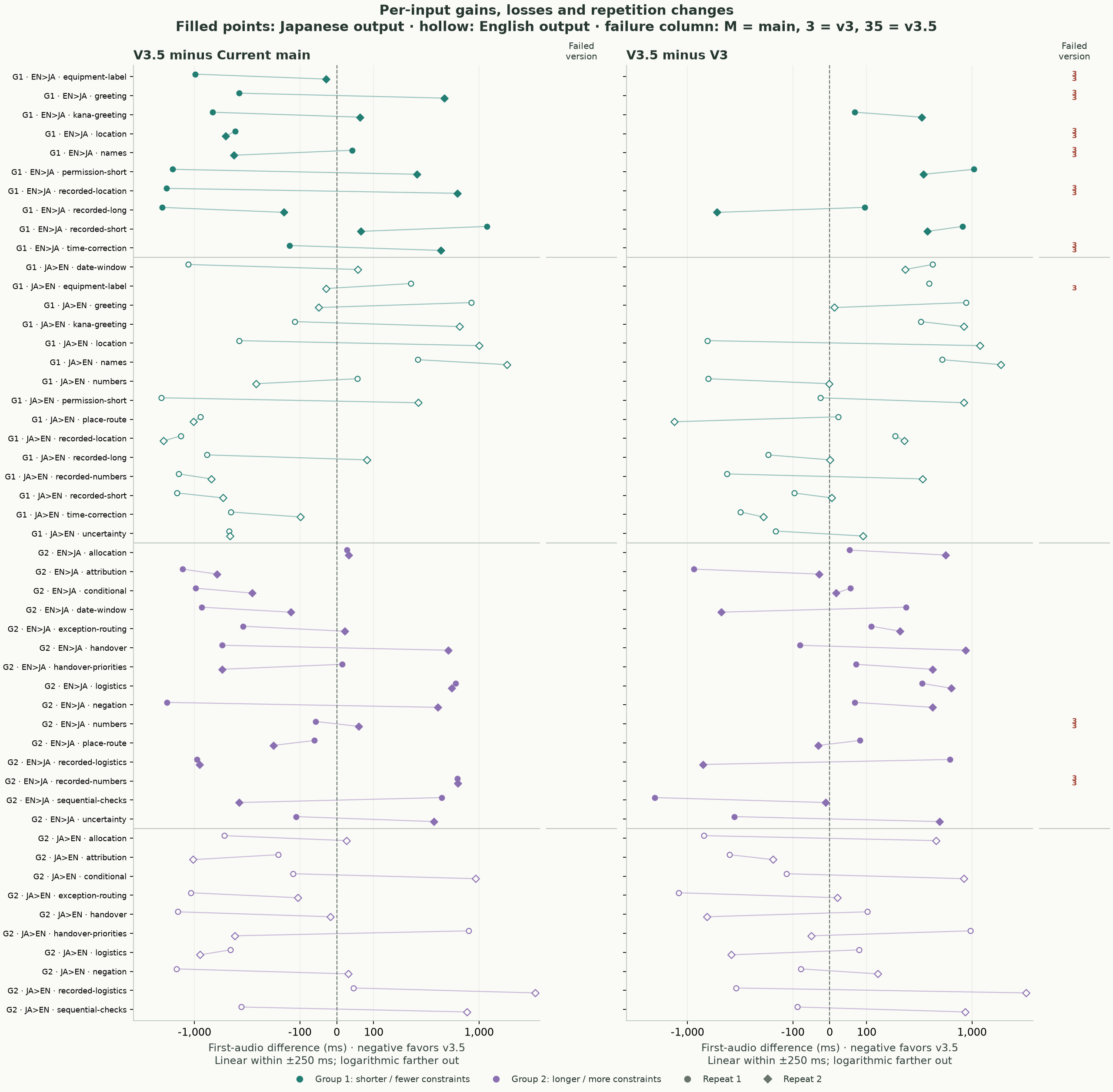
- V3 vs V2: the faster version switched between repeats for 16/41 inputs with two successful comparisons.
- V3.5 vs V2: the faster version switched between repeats for 26/50 inputs with two successful comparisons.
- V3.5 vs V3: the faster version switched between repeats for 22/41 inputs with two successful comparisons.
Two repetitions reveal variation but cannot establish a stable rule for choosing a version. Translated wording can differ between versions even when the source input is identical.
Explore and listen
Open a trial to compare its source, translations, guidance and saved clips at normal playback speed. Listening has not been scored. V3 and v3.5 stop speech when they cannot prepare the required reading; V2 may continue without guidance.
What changed between the versions?
| Behavior | V2 | V3 | V3.5 |
|---|---|---|---|
| Default request path | Separate recognition, translation and speech requests | Persistent server session | Same persistent server session as v3 |
| Japanese preparation target | 40 ms deadline; may continue without guidance | 40 ms target; awaits guidance | 40 ms target; awaits guidance |
| Required guidance | Optional selected rules | At least one valid rule | Guidance for every sentence and retained critical number/name readings |
| Pronunciation compiler | Original shared service | Original shared service | Separate repaired service |
| Temporary compiler failure | May continue without guidance | Speech stops | One retry after 100 ms before speech; unresolved failures stop |
| Unsupported reading | May generate ordinary pronunciation | Speech stops | Explicit reading or alignment message; speech stops |
Shared configured providers: Groq whisper-large-v3, Cerebras gpt-oss-120b and Fish s2.1-pro. Voice label SophiaClone, 44.1 kHz MP3 and normal speech speed are retained. Configuration and guidance metadata do not certify naturalness.
Two measurement segments
The same planned case order continued after the interruption. The first segment contains 20 inputs from repeat 1. The second contains the remaining 30 inputs from repeat 1 and all 50 from repeat 2. The two segments therefore contain different input mixes; the summaries below are descriptive, not evidence that the allowance change improved or worsened speed.
| Measurement segment | V2 | V3 | V3.5 |
|---|---|---|---|
| Original cases 1–20 15 Oct 03:57:08 UTC to 15 Oct 04:03:27 UTC | 20/20 audio 4/10 guided Japanese 1,025 ms median startup on 15 common successful trials | 15/20 audio 5/10 guided Japanese 1,203 ms median startup on 15 common successful trials | 20/20 audio 10/10 guided Japanese 913 ms median startup on 15 common successful trials |
| Resumed cases 21–100 15 Oct 04:14:25 UTC to 15 Oct 04:34:31 UTC | 80/80 audio 29/40 guided Japanese 1,168 ms median startup on 68 common successful trials | 68/80 audio 29/40 guided Japanese 845 ms median startup on 68 common successful trials | 80/80 audio 40/40 guided Japanese 1,042 ms median startup on 68 common successful trials |
Each segment’s timing median uses its own common three-version successful subset. The overall intervals retain each whole scenario family, including its observations in both segments. They describe these two observed periods; they do not estimate day-to-day service variation.
Method and evidence
Session routes may report preparation times of zero or near zero. Treat those as limited-resolution service telemetry, not evidence that guidance takes no time. The client’s first-audio and last-byte measurements remain the comparison measures.
The full plan balances six version-order permutations within input type and direction, then reverses each input’s order in a separately shuffled second round. All 100 planned trials and both repetitions are included in the completed report. One request chain runs at a time with no automatic job retries. V2 uses its normal HTTP sequence; v3 and v3.5 use established server sessions. Connection setup and pacing are recorded outside measured job timing.
Shared usage: 983 before the first segment → 1908 after the second. The daily allowance increased from 2,000 to 3,000 between cases 20 and 21, with approval. No counter reset and no replay of completed jobs. Other active users may contribute to the usage difference.
Raw responses · Analysis · Measurements CSV · Interpretation notes · Arithmetic verification · Audio integrity checks · Study plan · Versions before · Versions after
- initial-20: 60 jobs · original results SHA-256 fb55536fa36ae05b33fa91f900a136839f900353be4a208e31f1cb2e9c006d0a
- continuation-80: 240 jobs · original results SHA-256 3c227e55ad8ab93d994dd81ca79884d5ad83b4552d7c7a0e57c0870a8234d83f
Original measurement record SHA-256: 169ec5dbb8adb76fb1701e4414702ee6b62178b467c46c95de42627e31797c70